
The Cloud API Trap
Most small businesses dip into AI through a subscription. ChatGPT Team, Claude Pro, Copilot. It works — until the bill hits, the API changes terms, or the tool decides your data is training fuel.
Here's the part nobody advertises: every prompt you type into a cloud API leaves your business. Product descriptions, customer emails, financial summaries, internal docs. Out the door. Into someone else's model.
For a solo operator in Provo or a five-person shop in St. George, that's a real exposure. Not theoretical. Real.
What "Local LLM" Actually Means
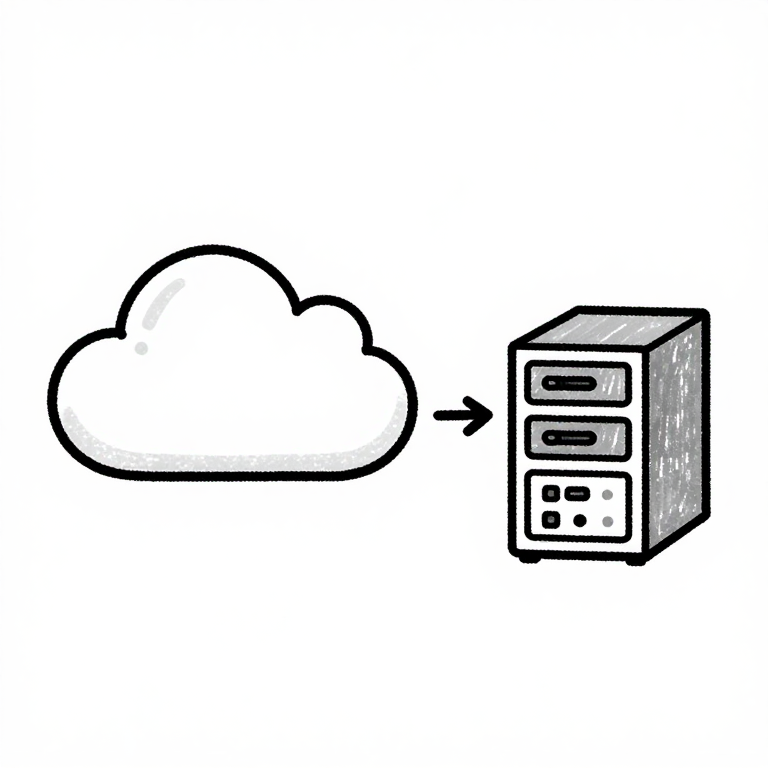
Running an LLM locally means the model lives on your hardware. Your Mac Mini. Your office server. Your machine, your rules, your data.
Popular options right now:
- Ollama — dead simple setup on macOS, Linux, Windows. Download a model, run it. Five minutes to first prompt.
- llama.cpp — lower-level, runs on almost anything. Raspberry Pi to Threadripper.
- LM Studio — GUI wrapper. If you can install Slack, you can run this.
You don't need a $10,000 GPU rig. A Mac Mini M4 with 16GB RAM runs 7B parameter models fine. An M4 Pro with 24GB handles 14B. That's enough for most business tasks: drafting emails, analyzing spreadsheets, summarizing meetings, writing product copy.
M4 Mac Mini — The Sweet Spot
The Mac Mini M4 is the most practical entry point for a small business running local LLMs. Here's why.
Price-to-performance is absurd. The base M4 Mac Mini starts at $599. Add RAM to 24GB and you're around $800. That's a one-time cost that replaces a $20-50/month cloud API subscription. It pays for itself in under two years — and that's before you factor in data privacy.
Real-world numbers. An M4 Pro with unified memory runs a 14B parameter model (Q4 quantization) at roughly 20-30 tokens per second. That's not "wait five minutes for a response" territory. That's conversational speed. Draft an email, get a reply, move on.
Silent and small. This isn't a rack server. It sits on a desk. No fan noise worth mentioning. No dedicated closet. For a small office that already has a Mac ecosystem, it's zero friction.
Dual-use machine. The Mac Mini isn't just an LLM box. It's a file server, a CI runner, a Home Assistant host, a ComfyUI workstation. You're not buying a single-purpose appliance. You're adding a general-purpose tool that also happens to run AI.
We've run Hermes Agent, Ollama, and ComfyUI on a Mac Mini M4 in this very workspace. It handles the workload. For a small business that needs local inference without the complexity of a Linux server, this is the play.
Related: Running Hermes Agent on a Mac Mini M4 | Your Personal AI Studio Setup
Why Utah Specifically
Utah's small business scene has a few things going for it that make local LLMs a natural fit.
Tech literacy is high. Silicon Slopes isn't just a slogan — there's a genuine density of technical operators across the Wasatch Front and growing in places like St. George and Cedar City. If you already self-host a website or run a NAS, a local LLM is one more service on the rack.
Data sensitivity is real. Utah has a healthy mix of healthcare companies, law firms, financial advisors, and government contractors. All of them handle client data that shouldn't touch a third-party API — whether it's HIPAA, attorney-client privilege, or ITAR-adjacent work. Local inference sidesteps that entirely.
Cost sensitivity matters. Margins in a five-person business are not Google's margins. A local LLM costs electricity. That's it. No per-token billing. No surprise invoice because someone pasted a 50-page spec into the prompt.
The Realistic Play
Nobody's suggesting you replace every AI tool overnight. Here's what a practical adoption path looks like:
Start with one use case. Drafting customer emails. Rewriting product descriptions. Summarizing meeting notes. Pick one thing your team does repeatedly and route it through a local model first.
Measure the gap. Is the output good enough? Does it save time? Does it keep your data internal? If yes, expand. If no, you didn't sink $200/month into a commitment.
Scale on your terms. Another use case. Another model. A dedicated machine. You own the whole stack. No renegotiating contracts. No migrating when a provider shuts down.
What It Won't Do
Local LLMs won't replace your brain. They hallucinate. They format things weird. They need guardrails.
Smaller models are dumber than GPT-4o. That's just true. A 7B model won't write a novel. It'll write a solid first draft of an email.
The sweet spot is structured, repetitive tasks where consistency matters more than brilliance. If your workflow fits that pattern, local LLMs earn their keep.
The Bottom Line
Running AI locally isn't about ideology. It's about control. Your data stays yours. Your costs stay fixed. Your tool doesn't change the rules mid-game.
For Utah's small business operators — the ones building things, shipping things, and grinding without a VC safety net — that's not a luxury. It's infrastructure.
// no comments on this post.